Keywords:
Digital surveillance, intelligence oversight , Southern Africa, surveillance scandals, public oversight
Synopsis
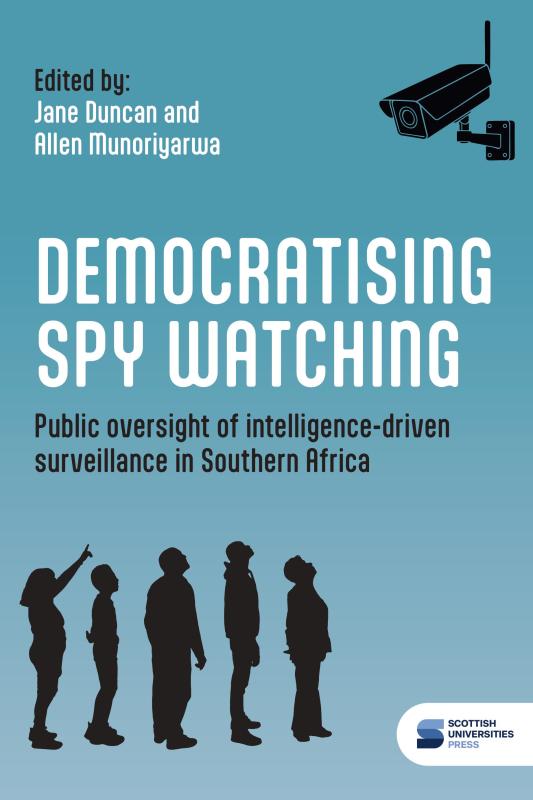
Digitisation has provided intelligence agencies with the capabilities to conduct surveillance at an unprecedented scale. Using a range of digital surveillance technologies and practices, and unprecedented public-private collaborations, intelligence agencies have extended their ability to collect, store and analyse data for intelligence purposes. Effective oversight is required to limit the potential for abuse. However, across Southern Africa – where digital surveillance is expanding – official oversight institutions typically lack the power and resources to monitor and review surveillance capabilities in order to ensure that intelligence agencies behave effectively and lawfully. Consequently, oversight in these countries typically is conducted by the public, through, for instance, challenging unjustifiable secrecy, publicising abuses and organising campaigns to rein these agencies in.
Through comparative case study research exploring lessons from key moments in the region, this volume explores public oversight of intelligence-driven digital surveillance in eight Southern African countries and examines cases where this oversight either succeeded, failed, or achieved mixed outcomes. Authored by researchers and journalists from the fields of law, communication and media studies, this book offers lessons for academics and activists, suggesting that a new model of public oversight of surveillance is possible, and, arguably, functions better than extant approaches to surveillance. It will be of global significance, as surveillance abuses are a worldwide problem, as is the problem of oversight failing to keep pace with expanding surveillance capabilities.
Downloads
Download data is not yet available.
Author Biographies
Jane Duncan, University of Glasgow
Jane Duncan is a Professor of Digital Society at the University of Glasgow, and she holds a British Academy Global Professorship at the same university. She is also a Visiting Professor at the University of Johannesburg. She is author of The rise of the securocrats (Jacana, 2014), Protest Nation (University of KwaZulu/ Natal Press, 2016), Stopping the spies (Wits University Press, 2018) and National security surveillance in southern Africa (Zed Books, 2022).
Allen Munoriyarwa , Walter Sisulu University
Allen Munoriyarwa is an Associate Professor of Journalism at Walter Sisulu University in South Africa, in the Department of Marketing, Public Relations and Communication. His research interests are in surveillance, digital journalism, and media cultures, as well as digital surveillance. He has published widely in these areas. He is the co-author of Digital Surveillance in Southern Africa: Policies, Politics and Practices (Palgrave Macmillan, 2022).
Rui Verde, University of Oxford
Rui Verde holds a PhD in Law from the University of Newcastle, UK, and a law degree from Universidade Católica de Lisboa, Portugal. He serves as Chief Legal Adviser to Maka Angola, an organisation committed to promoting democracy, defending human rights and combating corruption in Angola. An expert on Angola’s legal landscape, especially in matters concerning corruption, the exercise and integrity of judicial authority, the dynamics of contemporary politics, and the evolving landscape of surveillance and digital rights – he has published extensively on these topics. At the University of Oxford, he developed a research project examining China’s influence in Angola and has completed a study on the role of the Israeli surveillance industry in the country. Currently a Research Associate at the African Studies Centre, University of Oxford, and Chercheur Associé at CEPED, Université Paris-Cité, he also founded the think-tank CEDESA, which is dedicated to advancing development in Southern Africa.
Phillip Santos, Namibia University of Science and Technology
Phillip Santos teaches both undergraduate and postgraduate courses in the Department of Journalism and Media Technology at the Namibia University of Science and Technology and is Research Associate in the Department of Strategic Communication, University of Johannesburg. He also taught in the Department of Journalism and Media Studies at the National University of Science and Technology in Zimbabwe. He holds a PhD from Rhodes University in South Africa and co-edited the books Reading Justice Claims on Social Media: Perspectives from the Global South and Global Pandemics in the Media: An African Perspective. His research interests are in political and strategic communication; the mediation of science and health issues, social memory, gender, Justice and political struggle; the social and policy dimensions of new and broadcast Media, as well as the confluence between political Correctness, populism, post-truthism and democratic politics.
Borges Nhamirre , Institute for Security Studies
Borges Nhamirre is a researcher on peace, security and governance at the Institute for Security Studies (ISS Africa). Prior to joining ISS in 2021, he served as a senior researcher and research coordinator at the Centre for Public Integrity in Maputo. He holds a Master’s degree in Security Studies with a specialisation in Maritime Security from Joaquim Chissano University in Maputo, and he is currently pursuing a PhD in History of Ethnicity and Conflict in Northern Mozambique at Queen’s University Belfast (QUB), Northern Ireland. He also lectures on Nationalism and Liberation Movements in 20th-century Africa at the School of History, Anthropology, Philosophy and Politics at QUB
Ernesto Nhanale, Escola Superior de Jornalismo
Ernesto Nhanale is both an academic and a civil society activist, having served as the director of the Mozambique chapter of the Media Institute for Southern Africa for several years. He is also a Professor of Media and Journalism at Higher School of Journalism, an independent higher-education institution in Mozambique. He has undertaken extensive research work and produced publications in the area of political communication and journalism and is a co-founder of CEC – Centre of Interdisciplinary Studies of Communication. He recently completed a study on digital surveillance and authoritarianism in Mozambique.
Trésor Maheshe Musole , Université Catholique de Bukavu
Trésor Maheshe Musole is a Professor of International Law at the Catholic University of Bukavu, eastern Democratic Republic of the Congo (DRC). His area of expertise is peace, human rights, security and migration in the Great Lakes region, as well as freedom of expression and the right to asylum. He has experience in the judicial and human-rights field, having worked as a member of the body of judicial defenders at the courts under the jurisdiction of the Court of Appeal of Bukavu, and is currently a lawyer at the bar of South Kivu in the DRC. He recently completed a study on digital surveillance and privacy in DRC: balancing national security and personal data protection.
Frederico Links
Frederico Links is a Namibian governance researcher and a journalist focussing on state-related governance issues. He has coordinated and contributed to projects at national, regional and international levels. He is the lead researcher for Namibia in the eight-country digital-surveillance research project funded by the British Academy, through the University of Glasgow. He also recently contributed to a study on cybersecurity and cybercrime laws and their impacts on media freedom and free expression across the SADC region. Aside from his journalism and research work, Links is also the founding and current chairperson of the Access to Information in Namibia (ACTION) Coalition of civil society and media organisations and social activists. The ACTION Coalition has been instrumental in successfully advocating for an access to information law in Namibia since 2012. Links is the author of a large number of articles, reports and book chapters.
Sarah Chiumbu, University of Johannesburg
Sarah Chiumbu is an Associate Professor of Communication at the University of Johannesburg, South Africa. Prior to this, she served as a Senior Research Specialist in the Human and Social Development Research Programme at the Human Sciences Research Council (HSRC). She also spent seven years at the University of the Witwatersrand as a senior lecturer in Media and Communication Studies. She holds a PhD and MA in media studies from the University of Oslo, Norway. Her research interests encompass media, democracy and citizenship, digital media, policy studies and social movements.
Tachilisa Badala Balule , University of Botswana
Tachilisa Badala Balule is an Associate Professor of Law in the Department of Law, University of Botswana. He is currently the Deputy Dean in the Faculty of Social Sciences. He holds an LLB
degree from the University of Botswana, and LLM and PhD degrees from the University of Edinburgh, Scotland. His PhD research was on regulation of the media. Dr Balule has published in the area of freedom of expression, including media freedom and access to information, and on aspects of electoral laws. He has delivered papers on freedom of expression, media law and access to information at national and international conferences. He has also written on digital surveillance, data protection and privacy in Botswana, and has completed a study recently on this topic. Earlier this year, his research on digital surveillance was cited by both sides of the house in a parliamentary debate on the Criminal Procedure and Evidence (Controlled Investigations) Bill, that led to the Government of Botswana making significant concessions to the Bill’s critics.
Rafael Marques de Morais , Centro de Estudos Ufolo para a Boa Governação
Rafael Marques de Morais serves as the executive director of the Centro de Estudos Ufolo para a Boa Governação (Ufolo Center for Good Governance), and he is the founder of Maka Angola, the country’s leading anti-corruption watchdog.
Published
January 15 2026
Copyright (c) 2026 Jane Duncan; Rui Verde, Phillip Santos, Borges Nhamirre , Ernesto Nhanale, Trésor Maheshe Musole , Frederico Links, Sarah Chiumbu, Tachilisa Badala Balule ; Allen Munoriyarwa ; Rafael Marques de Morais